
Why fatigue reduces reaction time behind the wheel
Reaction time is not just how fast your foot reaches the brake
When people say reaction time, they often imagine the moment the driver presses the brake. In reality, much more happens before that.
First you need to notice the danger. Then understand it. Then decide what to do. Only after that comes the movement of your foot, hands and vehicle.
Fatigue mainly slows this invisible part: perception, evaluation and decision-making.
What happens in your head when you are tired
Driving forces the brain to make constant decisions. It monitors traffic, signs, distance, speed, mirrors and your lane position.
When you are rested, these processes run smoothly. When fatigue arrives, the brain starts saving energy. It filters stimuli worse, switches attention more slowly and misses details more easily.
Nothing dramatic has to happen at first. You simply predict less, brake later and return to full attention more slowly after each distraction.
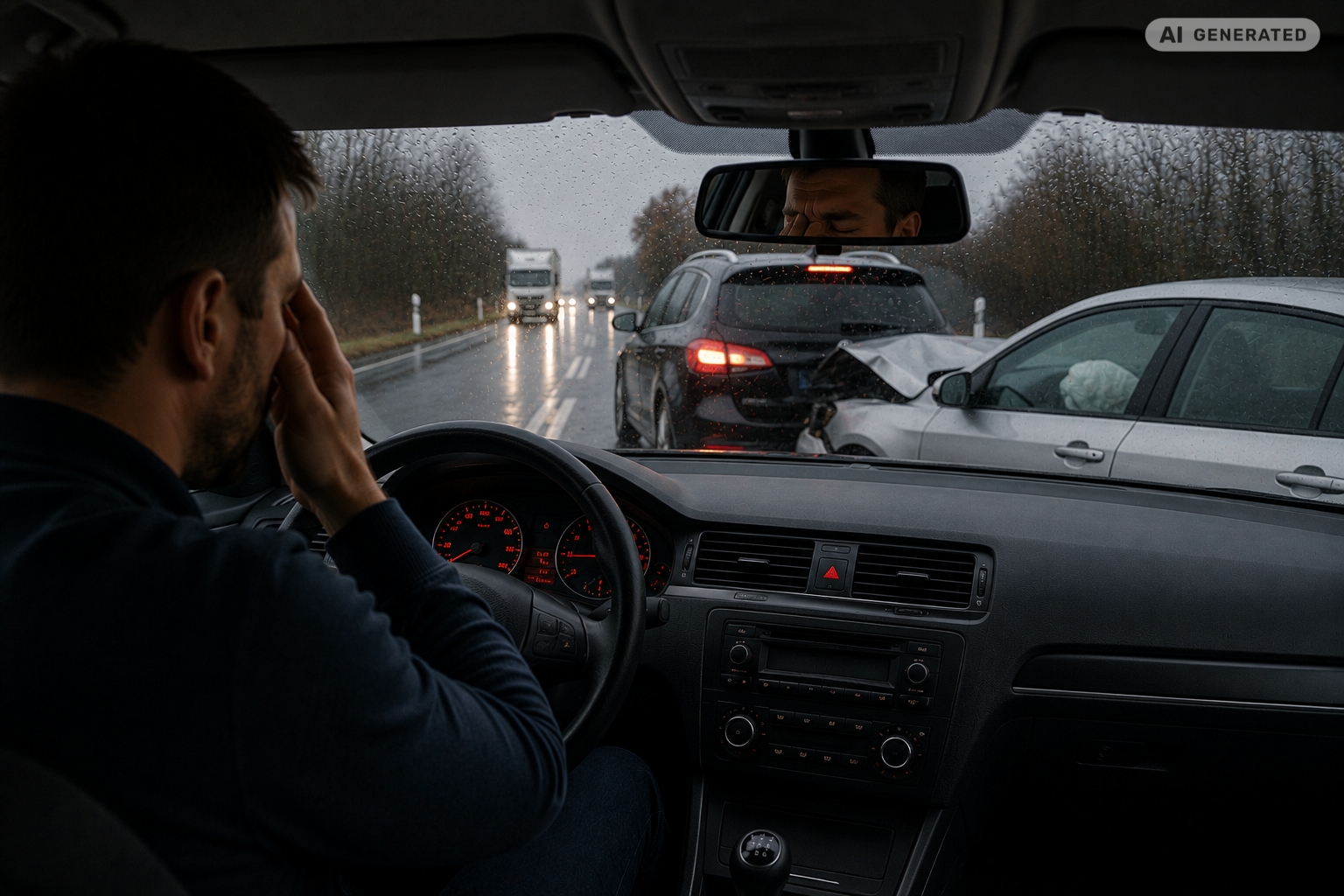
Why it is especially dangerous on highways
Highway driving often feels simple. The car is stable, the road is straight and for long minutes nothing special happens. But monotony is the problem.
When the environment does not change, attention naturally drops. A driver can slip into automatic mode. If the car ahead suddenly slows or traffic changes, a tired brain needs longer to wake up into action.
That is why reaction time connects directly with topics such as microsleep, long drives and planning breaks.
Související články v pillar systému
How to notice that your reactions are no longer the same
Reduced reaction time often does not arrive as one big warning. It appears in small signals that drivers easily excuse as boredom or a long route.
Pay attention especially when you notice:
These are not minor details. They show that your brain no longer has the same reserve.
- later reactions to brake lights
- more frequent steering corrections
- worse distance estimation
- a feeling of driving on autopilot
- unclear memory of the last kilometres
- more frequent startled reactions
- inner restlessness or dullness
- heavy eyelids and frequent yawning
Real driving experience: the problem is not only falling asleep
Many drivers think the biggest risk starts only when someone falls asleep. In reality, the phase before that is already risky.
Imagine a normal highway situation. Your family is in the car, the vehicle ahead is moving at the same speed, and your mind briefly drifts to work or the next stop. The car ahead brakes. You notice, but a little later.
That small delay can change the situation. Not because you cannot drive, but because fatigue has reduced the time available for a safe decision.
Safer driving starts before the crisis
The best solution is not to wait until the problem becomes obvious. With fatigue behind the wheel, the rule is simple: react before you have to.
Helpful steps include:
A break makes the most sense before fatigue is strong. If you stop only when you are fighting your eyelids, it is no longer comfort. It is safety.
- start rested
- avoid heavy food before driving
- drink water regularly
- plan breaks instead of waiting for a crisis
- switch drivers if possible
- keep a larger distance
- do not overestimate coffee or energy drinks
- stop safely at the first strong signs of fatigue
Where ATgreen fits in
ATgreen does not replace sleep, a real break or safe stopping. That needs to be clear. If you are seriously tired, the best solution is to stop, rest and not continue at any cost.
ATgreen products can be part of a personal travel ritual during a short break: step out, stretch, drink, calm the pace and create a more pleasant atmosphere for the next part of the journey.
For drivers who prefer a clean concept, ATgreen O₂ Classic is suitable. For a stronger feeling of refreshment during a pause, ATgreen O₂ Impulse Blend can be interesting. For more choice on the road, the ATgreen Test Set is practical.
Choose your ATgreen travel ritual
ATgreen O₂ Classic
ATgreen O₂ Classic is a simple aroma-free variant for drivers who prefer a clean and subtle travel companion.
View O₂ Classic →ATgreen O₂ Impulse Blend
ATgreen O₂ Impulse Blend is suitable for breaks when you want a stronger feeling of refreshment and a change of atmosphere during a long drive.
View O₂ Impulse Blend →Testovací sada ATgreen
The ATgreen Test Set helps you choose a variant according to the length of the trip, mood and the travel ritual that suits you best.
View Test Set →Topical hub: how this article fits the whole category
Reaction time is an important bridge between fatigue, microsleep and break planning. Once drivers understand that fatigue does not start only with closing eyes, they notice small changes in their driving earlier.
That is why this article links to related topics in the Driving and travel category and supports the whole pillar around long journeys, driver fatigue and safer breaks.
What to remember before your next long drive
Fatigue does not take driving ability all at once. It takes it gradually: attention, decision speed, distance judgement and finally safety reserve.
Do not wait for a dramatic warning. Build a system for long drives. Plan breaks, respect your pace and do not drive by force.
The safest journey is not always the fastest. It is the one where you stay alert enough until the destination.
Frequently searched questions
Why does fatigue reduce reaction time behind the wheel?
Because it slows perception, situation evaluation and the decision itself. A driver may brake or react later even while feeling focused.
How can I tell that I react more slowly?
Typical signs include later reactions to brake lights, worse lane keeping, startled reactions, autopilot feeling or unclear memory of the last kilometres.
Is only microsleep dangerous?
No. The phase before microsleep is already risky because attention, judgement and decision-making are weakened.
Does coffee or an energy drink help?
It can provide a short feeling of stimulation, but it does not replace sleep, rest or a quality break.
How often should I take breaks on a long drive?
Plan breaks in advance and do not wait for strong fatigue. Divide longer routes into smaller sections.
Which ATgreen product suits a travel break?
ATgreen O₂ Classic suits a clean concept, O₂ Impulse Blend suits a stronger refreshment feeling, and the ATgreen Test Set is useful for more options.
Create a safer rhythm for long drives
Connect planned breaks, more conscious driving and your own travel ritual. Choose an ATgreen variant that fits long routes and short stops.